
Tattnall Released Booking Photos
A booking photograph records appearance during intake. It remains linked to the arrest record even after release, but a photo does not establish conviction or explain the final case result. The Tattnall inmate inquiry displays image slots with current, 24-hour, and date-range rows. A person may disappear from Current Inmates after release, while an older booking trail remains available through an arrest-date search.
The online inquiry is not a certified release record. Its key status clue is RELEASED, and it does not show a clear public release-date field. Pair the photo and roster row with the court disposition or a sheriff's records response when the reason and date of release matter.
Find Tattnall Released Inmate Mugshots
No single photo source covers every Tattnall release. The official county web inquiry is the first photo channel for local bookings. GDC is the correct source for a person connected to Rogers, Smith, or another state facility. A registry photo has a separate legal purpose and should not be treated as a general jail-release photo.
| Channel | Photo? | How to access |
|---|---|---|
| Tattnall inmate inquiry | Image slots appear with roster rows | Search current, 24-hour, or arrest-date views |
| County records request | When legally releasable | Ask the custodian for the named booking photo |
| GDC offender search | Displays offender photos if available | Match the GDC ID and state record |
| GBI registry | May show a registry photo | Only for a person legally subject to registration |
| Regional news | Sometimes | Use only as context and verify officially |
| Commercial copies | May persist | Lower trust; do not use as official proof |
The Tattnall County release search provides the matching custody and court routes needed to place a photo in its proper record context.
Tattnall Uses a Web Inquiry
No Tattnall-specific sheriff mobile jail app was confirmed. The verified sheriff channel is the web-based inmate inquiry reached through the county jail inmates page. The roster pages carry image entries or placeholders beside booking details. This matters because many counties use apps, but Tattnall's confirmed public route is a website.
Search Current Inmates for someone still held. Use 24 Hours Arrests for a person booked in that rolling window, noting that it is a booking feed rather than a pure release feed. Use Inmates by Arrest Date for an older trail and inspect the status. The county says the inquiry is intended to be accurate and current and asks users to notify the Sheriff's Office about discrepancies.
A recently released person can be absent from the current list. Absence alone is not proof of release; it can also reflect a transfer, spelling mismatch, or data delay. The Tattnall 24-hour release page explains how RELEASED rows appear within the recent-booking view.
Request a Tattnall Booking Photo
When the web row no longer exposes an image, ask the custodian whether the booking photo is publicly releasable. Tattnall County's open-records page says requests may be oral or written, though writing is better for scope and timing. It also says charges may apply and the county will contact the requester before processing if so.
- Identify the person as shown in the jail inquiry and give the approximate arrest or booking date.
- Add the arresting agency, warrant number, case number, or court when known.
- Ask specifically for the public booking photograph tied to that booking.
- State a lawful, purpose-neutral request and ask whether O.C.G.A. 35-1-19 affects disclosure.
- Wait for any cost notice and the custodian's response before assuming the photo exists or can be released.
For questions about the county process, the research lists 912-557-4335. The sheriff's page lists 912-557-6778. A narrow request helps separate the photo from unrelated jail, medical, security, or protected material.
Note: Request the photo and the release record separately because Georgia applies special rules to booking-photograph disclosure.
Tattnall State Offender Photos
GDC's public disclaimer adds an important verification step. Before treating an offender record as factual and complete, written correspondence can be directed to Inmate Records and Information in Forsyth. Include the GDC ID and facility so the response concerns the correct person. A photo match without a matching identifier is not enough.
Historical Georgia State Prison images also belong in the state record path. The Reidsville prison closed in 2022, so a current Tattnall jail search cannot confirm an old state-prison photo or discharge. Use GDC records, parole records, and the related court case.
GDC Find an Offender is the official photo path for a person released from Rogers State Prison, Smith State Prison, historical Georgia State Prison custody, or another GDC facility. GDC states that offender photographs display automatically if available. Search by the strongest identifiers and confirm the facility and GDC ID before associating the image with a person.
A GDC offender photo is not proof of booking at Tattnall County Jail. It belongs to the state correctional record. Likewise, a county jail photo does not prove state-prison custody. If the online GDC record is incomplete, GDC advises verification through Inmate Records and Information at P.O. Box 1529, Forsyth, GA 31029.
Georgia Limits Mugshot Commerce
The text of Georgia's booking-photograph disclosure law is the primary source for the agency restriction.
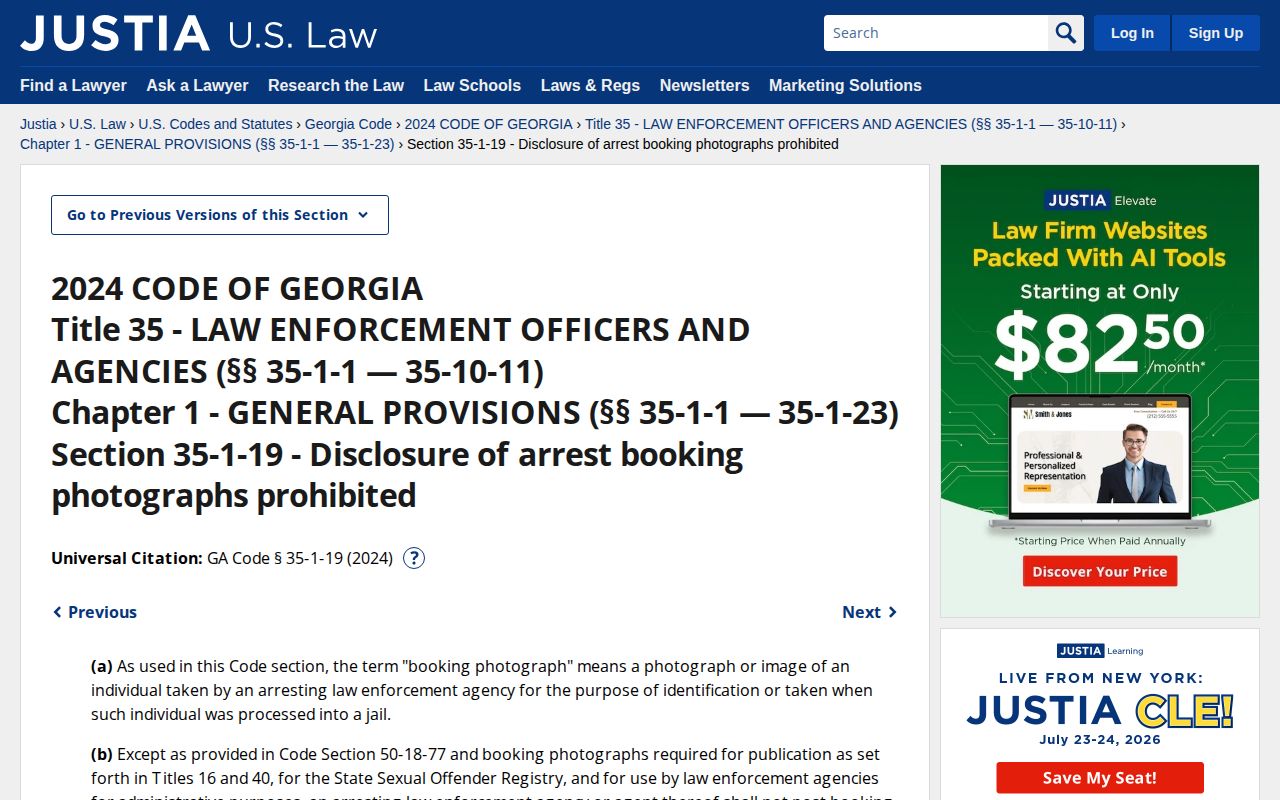
Its limits explain why a purpose-neutral request can still require legal review by the custodian.
O.C.G.A. 35-1-19 restricts a law-enforcement agency from providing a booking photograph when it may be placed in a publication or on a website that requires payment or other consideration for removal. That rule is central to a Tattnall photo request. Public-record status does not mean every photo must be supplied for every proposed use.
The Georgia Consumer Protection Division explains that O.C.G.A. 10-1-393.5 requires commercial mugshot websites to remove an arrest booking photograph at no charge within 30 days after a written request when one of the listed qualifying circumstances applies. The official consumer page, statute, custodian, and court are the proper sources. Fee-based removal firms are not endorsed.
Commercial copies may be stale even after a court disposition changes or official access is restricted. Send any qualifying request to the publisher holding the image and keep proof of delivery. The sheriff cannot control an independent publisher's copy merely because it created the original booking record.
Tattnall Restriction and Court Records
Georgia record restriction, first-offender treatment, sealing, and juvenile confidentiality can change public access. They do not all operate the same way, and none should be assumed from a missing online row. The Tattnall Clerk of Superior Court maintains criminal dockets and court records for the courts it manages. Ask the clerk what the public disposition shows and whether an order limits access.
A booking photo may persist in an archive or news story after the court record changes. The person seeking correction or removal should identify which entity hosts the image, then use the process that applies to that source. A court restriction does not grant a private party authority to alter a government record.
- Record restriction
- A legal limit on how eligible criminal-history information is disclosed.
- Sealing
- A court-controlled limit on public access to specified material.
- First offender
- A Georgia disposition with rules that may affect later record treatment.
- Juvenile record
- A record generally subject to stricter access limits.
Tattnall Registry Photos Differ
The GBI sex-offender registry may show a photo, registration status, offense information, and other public fields for a person required to register. Tattnall County's sex-offender page points to that statewide source. It is not a roster of all released inmates.
Use the registry only when the conviction and sentence require registration. A release from Tattnall County Jail does not by itself create a registry duty. Registry information also changes, so the GBI search and court record should be checked rather than relying on an old captured image.
Tattnall Custody News Context
Regional news may publish a custody image during an unusual event. WTOC reported a Tattnall Sheriff's Office search involving a missing inmate after a work-detail escape in 2025. Such coverage demonstrates why release, escape, and transfer must not be treated as synonyms.
An escape is not a lawful release. A news image can help identify the event being reported, but the sheriff, jail record, court, or GDC source must confirm later custody status. Routine released-inmate searches should never rely on a news photo alone.
Note: Local news can explain an event, but it does not replace the official Tattnall booking, release, or court record.
Photo identity should be checked with the same care as release status. A roster image can be missing, old, or linked to one booking among several. Compare the name, booking date, arresting agency, warrant number, and court before concluding that an image belongs to the event being researched. Physical appearance alone is not a reliable match.
The official source should also match the custody type. A GDC photograph can document a state offender record, while a Tattnall inquiry image belongs to a county booking. A GBI registry photograph concerns a separate registration record. Reusing one source to imply another kind of custody can create a false account even when the image shows the same person.
When a correction is needed, contact the entity displaying the image. The county can review its inquiry and records. GDC controls its offender record, and GBI controls registry data. A newspaper controls its own article. Commercial publishers have the Georgia removal rules described above. No single request automatically changes every copy.
Keep the request factual. Identify the exact URL or record, explain the claimed error or qualifying circumstance, attach the relevant official disposition when appropriate, and retain proof of submission. Avoid sending sensitive identity documents unless the recipient's official process requires them and the channel is verified.