
Releases from Immigration Custody and ICE
No official evidence in the research identifies Tattnall County Jail as an ICE contract detention facility. Immigration custody still matters because a local detainer can lead to transfer after county charges are resolved. A county row marked RELEASED may mean release from the Sheriff's custody only.
ICE says ODLS covers people currently in ICE custody, people in CBP custody longer than 48 hours, and people released from ICE custody within the last 60 days. That limited window differs from a permanent historical index. Older immigration custody questions may require direct agency or court records.
How to Confirm a Release from Immigration Custody and ICE
Open the official ICE Online Detainee Locator System. The strongest search uses the A-number and country of birth. Without an A-number, ICE requires exact first name, last name, and country of birth, with date of birth used in the identity path.
- Enter the A-number without guessing digits.
- Select the correct country of birth.
- If needed, switch to the exact-name search.
- Repeat legal name variants only when supported by known records.
- Read whether the result indicates current or recent ICE custody.
- Contact the relevant ICE channel when no result appears but a transfer is documented.
The Tattnall County custody overview explains how to check the local booking before moving to ICE.
Immigration Custody and ICE Records and Contact
ODLS is the public lookup, not a Tattnall facility contact. The county Sheriff can confirm when local custody ended or whether a public booking record notes transfer, while ICE controls immigration detention information.
ICE Custody Sources
Online Detainee Locator System
ICE locating-individuals fact sheet
Local jail: 912-557-6778 for Tattnall booking routing
Keep the requests separate. Ask the Sheriff for the county release or transfer record. Ask ICE about immigration custody. A court file may supply another part of the trail.
ICE Locator Coverage
The ICE locating-individuals fact sheet is shown below.
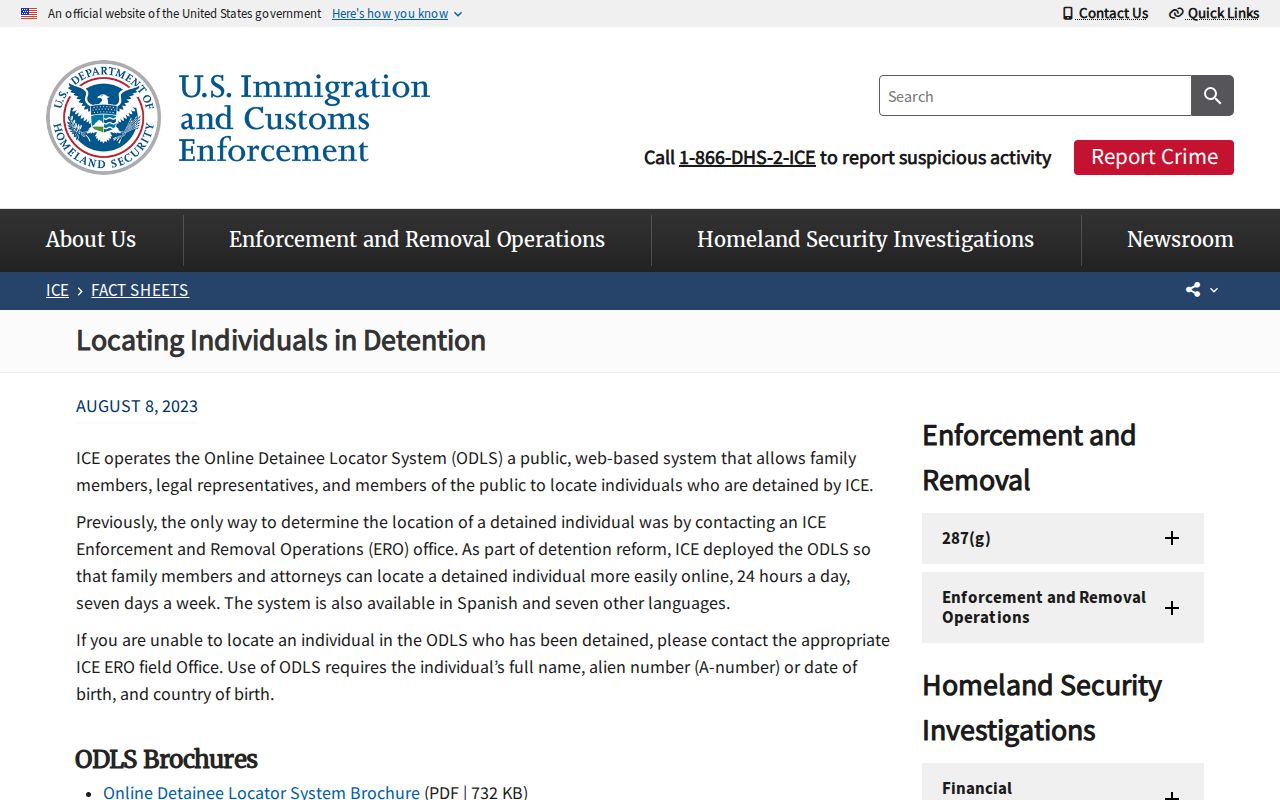
The fact sheet confirms the locator's identity fields and custody scope.
ODLS exact-match rules can make a valid person hard to find when a name is misspelled or reordered. An A-number is more precise. The 60-day recent-release limit also means an older release may no longer appear through the public tool.
| Custody question | Correct source |
|---|---|
| Current or recent ICE custody | ODLS |
| County booking exit | Tattnall Sheriff |
| State prison custody | GDC |
| Federal prison custody | BOP locator |
| Court action | Relevant court |
A no-result screen should be treated as inconclusive when a documented transfer occurred.
Tattnall Release Versus ICE Transfer
A detainer is a request from another authority concerning custody. If local charges end and ICE assumes custody, the jail can accurately mark the person released while the person remains detained elsewhere. Confirm the Sheriff's event first, then perform the separate ODLS check.
Release from ICE may occur under conditions or through another immigration process. The public locator does not replace legal records or advice. It is a custody-status tool with a limited recent-release window.
Tattnall Immigration Transfer Trail
No official evidence in the research shows that Tattnall County Jail operates as an ICE contract detention facility. Even so, an immigration detainer can affect the path out of local custody. A person may finish the local case, post bond, or otherwise leave the Sheriff's legal custody and then move to ICE. The public county row may only say RELEASED. It may not describe the immigration destination.
Build the trail in order. First confirm the local booking through the Tattnall inmate inquiry. Then request the exact county release time, release authority, and transfer destination if those public fields are needed. Next search ODLS. The Sheriff's Office can explain its own record but cannot certify what happened after ICE assumed custody. ICE, immigration court records, and counsel are the proper sources for the later immigration phase.
Search ICE With Exact Identity
ICE describes two public search paths. The preferred route uses the A-number and country of birth. The alternate route uses first name, last name, and country of birth, with date of birth as part of the identifying information. ODLS performs exact-match searching, so spacing, spelling, name order, or a missing legal name can prevent a match.
An A-number is the most useful key because names can repeat and change form across records. Do not guess it. If only the Tattnall booking is available, compare the full legal name, date of birth, arrest date, and any documented agency information before searching. A county nickname or shortened name may not match ICE's record. If a valid transfer is documented but ODLS returns nothing, contact the appropriate official channel rather than treating the blank result as proof of release.
- A-number
- An immigration registration number used to identify a person in immigration records.
- ODLS
- ICE's Online Detainee Locator System for covered current and recent custody records.
- Detainer
- A request or notice from another authority that may affect custody movement.
- Exact match
- A search rule requiring entered identity data to correspond closely with the stored record.
ICE Release Window Limits
ICE guidance says ODLS contains information about people currently in ICE custody and those released from ICE custody within the last 60 days. It also covers people in Customs and Border Protection custody for more than 48 hours. These limits make ODLS useful for a current or recent event, but not for every historical immigration detention.
A person released more than 60 days ago may no longer appear through that recent-release coverage. A person in very recent CBP custody may also fall outside the stated time threshold. Data entry and transfer timing can add uncertainty. For that reason, record the date and time of each search, keep the identity details used, and compare the result with the county transfer record or immigration case trail.
| Situation | What ODLS can do |
|---|---|
| Current ICE detention | May identify the covered custody record |
| CBP custody over 48 hours | Falls within ICE's stated locator scope |
| ICE release within 60 days | May remain visible as a recent release |
| Older ICE release | May require records or case channels |
| County-only booking | Use the Tattnall inmate inquiry instead |
Verify an ICE Custody Change
The safest verification chain begins with the agency that made each change. A Tattnall release record can confirm when local custody ended. ODLS can show a covered current or recent immigration custody result. An immigration court record may explain case proceedings, while counsel can address an individual legal situation. One source should not be made to answer for all of them.
- Save the exact identity shown in the county booking.
- Confirm whether the county row indicates release, transfer, or only absence from Current Inmates.
- Ask the Sheriff for public release or transfer fields when the online row is unclear.
- Search ODLS first by A-number and country of birth when possible.
- Try the exact legal-name route with the correct country of birth if no A-number is known.
- Escalate to official ICE or case channels when a documented transfer yields no public match.
GDC Find an Offender and the Georgia parole tools do not verify ICE detention. BOP's locator also serves a different federal prison system. A person can have records in more than one system over time, so compare dates and case identifiers before linking the records.
Requesting the County Release Record
Tattnall County directs requests to the custodian of the sought record. Written requests are recommended because they preserve the scope and timing. Include the requester's name, phone number, return address, and a specific list of records. Add the detained person's full name, booking date, approximate release date, location, and case or warrant number when known. The county warns that charges may apply and says it will contact the requester before processing when they do.
For a possible ICE transfer, ask for the public booking record, release date and time, release type or authority, and transfer destination or receiving agency if available for release. The county open-records question line is 912-557-4335. The Sheriff's main line is 912-557-6778. Keep the request focused on the county event. Immigration detention documents belong with the federal custodian, not with the county clerk or GDC.
The Georgia Open Records Act governs the state and local request baseline, subject to exemptions. It does not turn ICE records into county records. If the Sheriff withholds a county document, the county instructions state that the legal exemption should be cited. A federal response follows the applicable federal process.
ICE and Other Custody Systems
Tattnall search results can span four distinct systems. The Sheriff's inquiry covers county bookings. GDC covers Rogers State Prison, Smith State Prison, and other state placements. BOP covers federal prison records. ODLS covers specified ICE and CBP custody. A status in one database does not cancel or confirm a status in another.
Transfers are the key risk. A person can disappear from Current Inmates because the county no longer holds them, yet appear in ODLS after ICE processing. Another person may be released from ICE but later remain involved in an immigration case. Use precise phrases such as “released from Tattnall County custody” or “released from ICE custody” so the record claim stays tied to the agency that made it.