
Tattnall Parole and Probation
A person can leave Tattnall County Jail, Rogers State Prison, or Smith State Prison and still have rules to follow. Parole is conditional release from a prison sentence before the maximum term ends. The Georgia State Board of Pardons and Paroles makes that release decision. Felony probation comes from a Georgia court. The Georgia Department of Community Supervision, usually called DCS, provides field supervision for both felony probationers and parolees.
The county jail inquiry does not serve as a complete supervision index. It may show a new arrest tied to a violation, warrant, or hold, but that row is a new custody event. It does not by itself prove the alleged violation or a new conviction. For an overview of the original custody and release trail, use the Tattnall County released-inmate search paths and then move to the correct supervision source.
| Question | Parole | Probation |
|---|---|---|
| Who orders it? | State Board of Pardons and Paroles | Sentencing court |
| What comes first? | Part of a prison sentence is served | A court may impose it alone or in a split sentence |
| Who supervises? | DCS in the community | DCS for felony probation |
| Best public starting point | Parolee Search | Court disposition and DCS office |
| How it ends | Discharge, revocation, or sentence completion | Court-ordered completion, discharge, or revocation |
Verify Tattnall Post-Release Supervision
Start with identity, not a status label. Similar names can produce the wrong result. The Board's Parolee Search accepts partial terms and offers first name, last name, race, case number, UPI number, and GDC ID fields. A matching parole record is stronger when the GDC ID or case number also agrees. DCS should then be used for local supervision routing, while the sentencing court remains the best source for probation terms.
- Check the Tattnall jail inquiry or GDC record to learn whether the release came from county jail or state prison.
- Search the Board's Parolee Search by full name, then narrow the match with a case, UPI, or GDC number.
- If probation is suspected, identify the sentencing court and request the judgment, sentence, or later supervision order.
- Contact the DCS Claxton field office for procedural and office-routing questions about Tattnall supervision.
- Check the jail and court again if a warrant, hold, or violation booking appears. Do not treat an arrest entry as a final ruling.
Some supervision information is restricted. The local office may confirm where a matter should be directed without releasing private case details. A certified court order or official agency record is more reliable than an uncited copy of a status found elsewhere.
Note: A parole result confirms a supervision status, not the exact reason or hour the person left the releasing facility.
Claxton Office Serves Tattnall
The official DCS felony-supervision overview shows Georgia's community-supervision role.
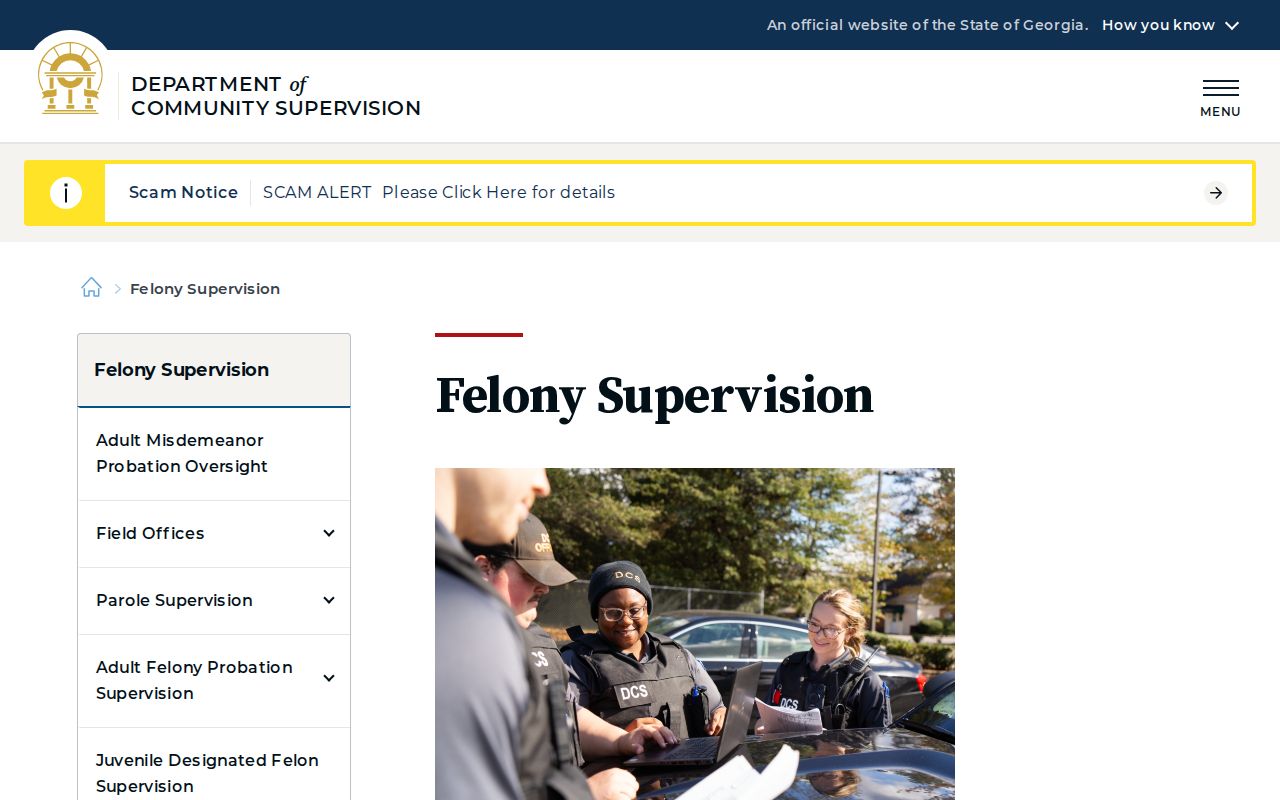
That statewide role leads locally to the Claxton office serving Tattnall.
Tattnall County's local DCS field office is in Claxton, not Reidsville. The office serves Tattnall and other counties in the Atlantic Circuit. That location is the key local connection for people living in or reporting from Tattnall after felony probation or parole release. It does not make parole decisions and should not be used as an appeal route for a Board decision.
DCS Claxton Field Office105 Daniel Street
Claxton, GA 30417
912-739-9612
Monday through Friday, 8:00 a.m. to 4:30 p.m.
Statewide DCS contact: 678-783-4337
Ask which office holds the supervision file, what public process applies, and which court or Board unit owns the decision in question. Do not assume the office can reveal a person's reporting schedule, address, treatment details, or other protected supervision data.
Tattnall Parole Timing Tools
Georgia separates pre-release parole timing from current parole status. The Inmate TPM lookup concerns a person still in prison or still in the parole-consideration process. TPM means Tentative Parole Month. It is a planning marker, not a promise that release will occur in that month. The Board may conduct a final review at the TPM and decide whether to set or change a release date.
For someone already released on parole, use Parolee Search instead. The Board explains that most parole-eligible inmates become statutorily eligible after one-third of a prison term, but few receive parole at first eligibility. Eligibility is only the point at which review may occur. It is not a grant. Serious violent offenses and repeat-offender rules can change the ordinary framework under O.C.G.A. 42-9-45 and O.C.G.A. 17-10-6.1.
Tattnall Parole Decisions Aren't Hearings
Georgia does not hold routine public county-level hearings where an inmate appears and argues for parole. The Board reviews cases through its statutory process, guidelines, investigation, and member decisions. Its monthly public meetings address policy and agency operations. A published Board meeting notice states that offender cases are not considered and parole decisions are not made at those meetings.
Possible case outcomes can include a TPM, a changed TPM, denial or later reconsideration, release on parole, rescission before release, max-out without parole, or revocation after release. Wording may differ by record. The Georgia parole process and the person's own TPM or parole status are the right sources. A public meeting calendar should never be presented as a schedule of Tattnall inmate hearings.
Tattnall Warrants and Absconders
An absconder is a person alleged to have stopped reporting or otherwise left supervision without authorization. A violation warrant can lead to a new jail booking. Tattnall's public roster has displayed probation-violation and parole or pardons wanted-person language, which shows how post-release supervision can return someone to county custody. The roster describes the booking or hold; it does not settle the violation case.
Use three records together. Parolee Search addresses parole status. DCS handles field supervision. The Tattnall jail inquiry and the proper court show a new local custody event and its case trail. A parole or probation violation may arise from missed reporting, an alleged new offense, or another claimed breach, but only the responsible authority can establish what occurred.
- Absconder
- A person alleged to have stopped complying with required supervision contact.
- Violation
- An alleged breach of a parole or probation condition, not automatically a new conviction.
- Revocation
- An official decision that can return a person to custody or change supervision.
- Discharge
- The formal end of parole, probation, or the sentence obligation reflected by the controlling record.
Tattnall Reentry Through Claxton
Tattnall's state-prison landscape creates a distinct release path. Rogers State Prison and Smith State Prison are active GDC facilities in the county. Some people connected to Smith may later move through Smith Transitional Center in Claxton. GDC says Smith State Prison is the host facility even though the transitional center lies in Evans County.
The trail may therefore read prison, transitional placement, parole or sentence discharge, and DCS supervision when required. A transfer to the transitional center is not the same as full community release. Check GDC for custody and facility status, the Board for parole timing or current parole, and DCS for field-supervision routing. This prevents a Tattnall search from ending merely because the person no longer appears at Rogers or Smith.
Tattnall Supervision Conditions and Discharge
The source record also depends on how the sentence was built. A probated sentence can place a person under court-ordered supervision without a state-prison release. A split sentence can combine confinement with probation afterward. Parole, by contrast, is a Board decision during a prison sentence. The same DCS officer may work with both groups, but the legal authority behind the supervision remains different.
For a probation question, obtain the judgment and sentence from the court identified in the jail row or case record. It may state the length of supervision and whether confinement received credit. For parole, compare the GDC identity with the Board's Parolee Search. A DCS office can route procedural questions, but it does not rewrite the sentencing order or substitute for a Board record.
Transfers also require care. Moving from Smith or Rogers to Smith Transitional Center is still a GDC placement, not proof that parole has started. A person may later leave through parole, max-out, or another authorized discharge path. Confirm the status at each stage rather than using the last known facility as the final answer.
When supervision ends, ask for the record that reflects completion. A missing Parolee Search result, an empty roster search, or no recent DCS contact is not enough by itself. Names can be entered differently, public tools can lag, and private supervision details can be withheld. The final court, Board, DCS, or GDC record should carry the conclusion.
Parole and probation may include reporting, lawful conduct, travel limits, financial duties ordered in the case, or other person-specific conditions. The exact terms come from the Board, sentencing court, and supervision documents. A general agency page cannot establish the conditions in one person's case. The Board's parole conditions provide statewide context, while the controlling order supplies the actual rules.
Supervision ends only through an official action or expiration reflected by the responsible authority. A person may complete the term, receive a discharge, face a revocation, or return to custody. When the status matters, request the final Board, DCS, or court record rather than inferring discharge from the absence of a current jail row.
Note: Leaving Tattnall custody and ending Georgia supervision are separate events that may occur months or years apart.