
Tattnall Projected and Actual Release
A projected date is an agency's present calculation based on the sentence, credit already entered, applicable earned time, and known restrictions. It can also refer to a Tentative Parole Month, or TPM, in the Georgia parole process. Neither is the same as the actual release timestamp. Actual release occurs only after staff clear the order, sentence calculation, warrants, detainers, property, and destination.
A person awaiting trial usually has no sentence-expiration date. The controlling events may be bond, a later court order, case disposition, or transfer. The Tattnall roster's arrest date and days-in-jail fields do not create a promised release date. A sentenced person has a calculation, but it may still change.
Find a Tattnall Projected Date
Begin with the custody source. Tattnall County contains the county jail plus Rogers and Smith state prisons, so a county-name search can lead to the wrong system. Georgia State Prison in Reidsville closed in 2022, and historical questions about it also belong with GDC records rather than the live county roster.
- Check the Tattnall inquiry to decide whether the person is held at the county jail, released locally, or transferred.
- For a county sentence, ask the jail records unit for the public calculation and the clerk for the sentence order and jail credit.
- For a state prisoner, use GDC Find an Offender and match the GDC ID, facility, status, and available release information.
- Check the Inmate TPM lookup when parole timing is relevant. Treat TPM as tentative.
- Ask the responsible office to confirm the date when a court change, discipline, detainer, or parole action is known.
The Tattnall County release record paths help identify the correct custodian when the person has already left the visible roster.
Tattnall County Earned-Time Rules
O.C.G.A. 42-4-7 addresses county inmate records and says a county inmate sentenced to confinement is released at sentence expiration less earned-time allowances. That language supports an earned-time calculation, but it does not supply enough facts to calculate one person's day. The jail needs the sentence start, sentence length, credit for time already served, earned-time status, disciplinary record, and all holds.
Do not subtract a generic percentage from the sentence. Pretrial time and sentenced time are different. A court may award jail credit, while the jail applies the controlling record and lawful allowances. Ask for the sentence order and calculation rather than relying on an arrest date shown online.
- Jail credit
- Time the court or custodian applies toward the sentence under the controlling record.
- Earned time
- A lawful allowance that can affect a county sentence calculation.
- Detainer
- A request or legal basis for another authority to take or continue custody.
- Discharge
- Completion of the sentence or supervision obligation shown by the official record.
Tattnall State Prison Timing
The Board's Georgia Inmate TPM explanation shows why a tentative month is not a firm release date.
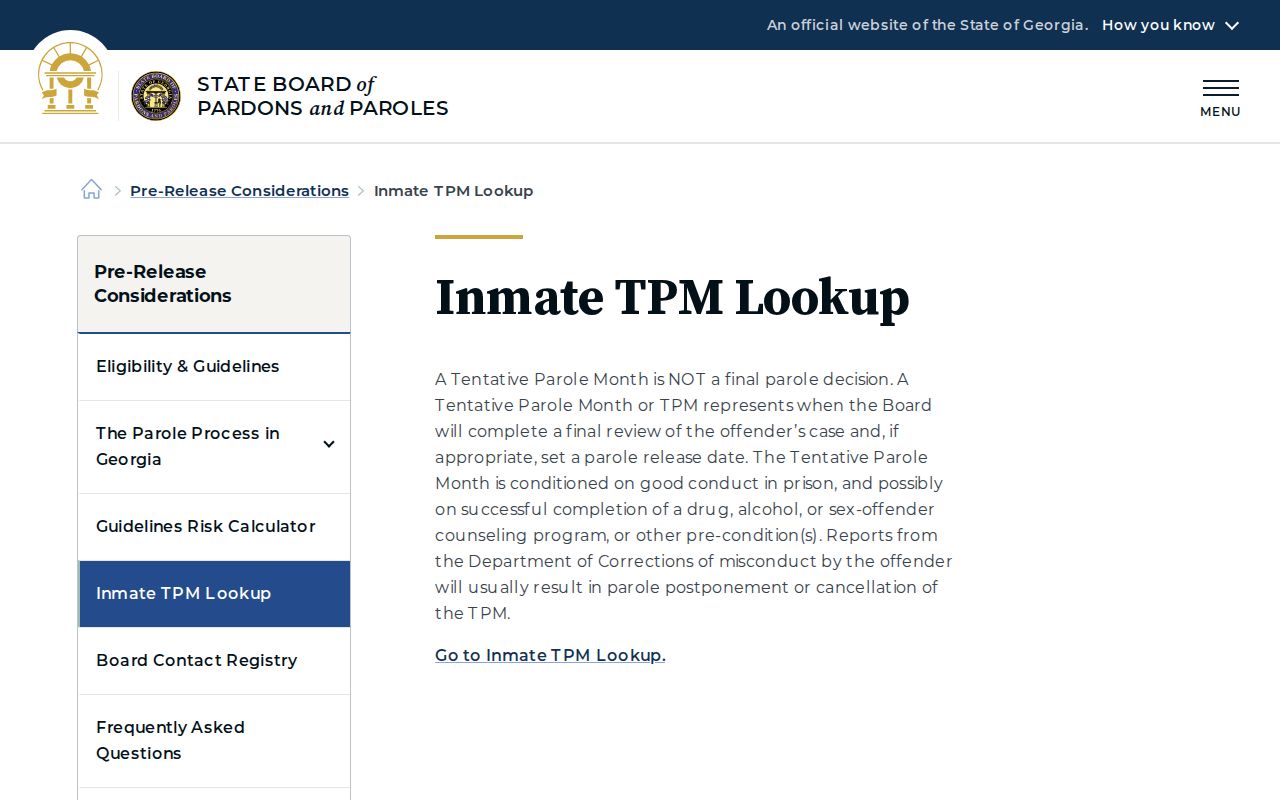
The lookup belongs to parole timing, while GDC maintains the custody record.
State-prison timing follows GDC and Board records, not the county jail calculation. GDC public guidance says Find an Offender can provide release-date information, charges, and facility location. For Rogers, Smith, another GDC prison, or a transitional center, match the person by GDC ID whenever possible. GDC advises written verification through Inmate Records and Information, P.O. Box 1529, Forsyth, GA 31029 before treating online data as complete.
TPM means Tentative Parole Month. The Board can review the case at that point and decide whether to set a release date. Most parole-eligible prisoners may become eligible after part of the term, but eligibility does not guarantee release. The Board's decision guidelines are part of the framework, not a personal result.
Why Tattnall Release Dates Change
A projected date reflects current information. New lawful entries can move it forward or back. The record should identify the authority behind a material change; an unexplained date copied from a prior screen may be stale.
| Factor | Possible effect | Source to check |
|---|---|---|
| Earned-time award or loss | Changes the county or agency calculation | Jail or GDC records |
| Corrected jail credit | Changes time applied to the sentence | Sentencing court and custodian |
| Disciplinary action | May alter available credit under applicable rules | Custody agency |
| Detainer or warrant | May cause transfer or continued custody after one case ends | Holding and requesting agencies |
| New court order | May amend, vacate, or clarify the sentence | Court clerk |
| Parole action | May set, change, deny, rescind, or revoke release | Parole Board |
A county row marked RELEASED may mean release from Tattnall custody only. It can still be followed by GDC, another county, federal, or immigration custody.
Serious Tattnall Sentence Limits
The Board's public material distinguishes eligibility from favorable action. An eligible prisoner is considered through the parole process, but the Board can deny release, defer review, change a TPM, or conduct final review before authorizing a date. Public monthly Board meetings concern policy and operations and do not decide individual offender cases in an open county hearing.
That distinction matters near a projected month. Family plans, transportation, and supervision reporting should not be based only on an eligibility estimate or an old TPM. Check the current TPM source, GDC record, and any later Board status. If parole has already begun, Parolee Search is the released-person path, while DCS handles field supervision through the Claxton office serving Tattnall.
O.C.G.A. 17-10-6.1 defines serious violent felonies and imposes mandatory-minimum and parole limits for covered offenses. O.C.G.A. 42-9-45 supplies general parole eligibility and exceptions, including rules described for certain serious violent cases. These restrictions mean a simple one-third estimate can be wrong.
Only the judgment, offense of conviction, sentence structure, and official Board or GDC calculation can show which rule applies. A charge on the jail roster is not the same as a final conviction. Use the court disposition before drawing a conclusion about a mandatory term or parole bar.
Note: Eligibility marks when parole review may occur; it does not create a guaranteed Tattnall County release date.
Tattnall's Dual Date Systems
The court record adds another layer. A sentencing order may show confinement, probation, a split sentence, credit, or a later amendment. The jail or GDC then applies that controlling record through its own calculation. If a public screen omits the basis for the displayed date, request the order and calculation from their separate custodians.
Parole and sentence expiration also answer different questions. Parole allows community release under conditions before the maximum sentence ends. Max-out or discharge reflects completion under the controlling record. A parole date can be rescinded before release, while a maximum date can still lead to another agency's custody if a valid hold exists.
For historical Georgia State Prison records, current Tattnall jail pages are not useful. The former prison closed on February 19, 2022. Direct old release and sentence questions to GDC, parole, and court records, using the person's GDC identifier and former facility when known.
Tattnall projected-date searches are unusually easy to misroute because two active GDC prisons sit in the county. A person at the county jail may be pretrial or serving a local sentence. A person at Rogers or Smith is in state custody. Smith Transitional Center can also appear in a later reentry path even though it is in Claxton and hosted by Smith State Prison.
County earned time under O.C.G.A. 42-4-7 belongs to the county-sentence calculation. State parole timing uses GDC records, TPM, eligibility law, and Board action. A move from prison to a transitional center is a custody placement, not necessarily full release. Keep those systems separate at every step.
Confirm a Tattnall Release Date
Confirmation should state whether the date is a maximum possible release, tentative parole month, scheduled discharge, or actual release. Those labels answer different questions. Ask whether the calculation includes jail credit already awarded and whether an active detainer will change the destination.
For a county inmate, reconcile the clerk's filed order with the jail calculation. If they appear to conflict, request clarification instead of choosing the earlier date. For a state inmate, retain the GDC identifier and search date so a later update can be compared accurately.
A transfer date also needs care. It may end one facility's custody without ending the sentence, supervision, or another agency's hold. Ask where the person went and which office owns the next record.
Use Georgia VINE for a custody-change alert, then verify the result with the custodian. The Tattnall VINELink check explains how to select one person and register. VINE may report release or transfer, but it is not the certified sentence calculation.
For county custody, contact the Sheriff's Office and the sentencing clerk. For state custody, check GDC and, when applicable, the Parole Board. Ask for the public date, the type of date shown, and whether another hold affects physical release. A precise question is more useful than asking only when someone gets out.
GDC Inmate Records and InformationP.O. Box 1529
Forsyth, GA 31029
GDC contact channels
Note: Verify again near the projected day because court, credit, parole, and detainer records can change after an earlier search.
Record the date and source of each check. That simple log makes later changes easier to trace and explain.
A records request should be narrow enough for the custodian to identify the calculation. For a Tattnall County Jail sentence, include the person's roster name, arrest or booking date, case or warrant number, sentencing court, and the specific public date or calculation requested. The county advises written requests for clarity and says it will contact the requester before processing when charges may apply.
For GDC, include the full name, GDC ID, birth date if known, facility, and county of conviction. State whether the request concerns the maximum possible release date, actual release date, discharge status, parole release, or facility history. Those labels reduce the risk that a response supplies a different date than the one being researched.
The court and custodian can each hold part of the answer. The clerk keeps the filed sentence and amendments. The jail or GDC applies credits and agency rules. The Parole Board controls parole action. When a projected date appears wrong, compare these sources in that order rather than attempting an independent sentence calculation from a roster row.